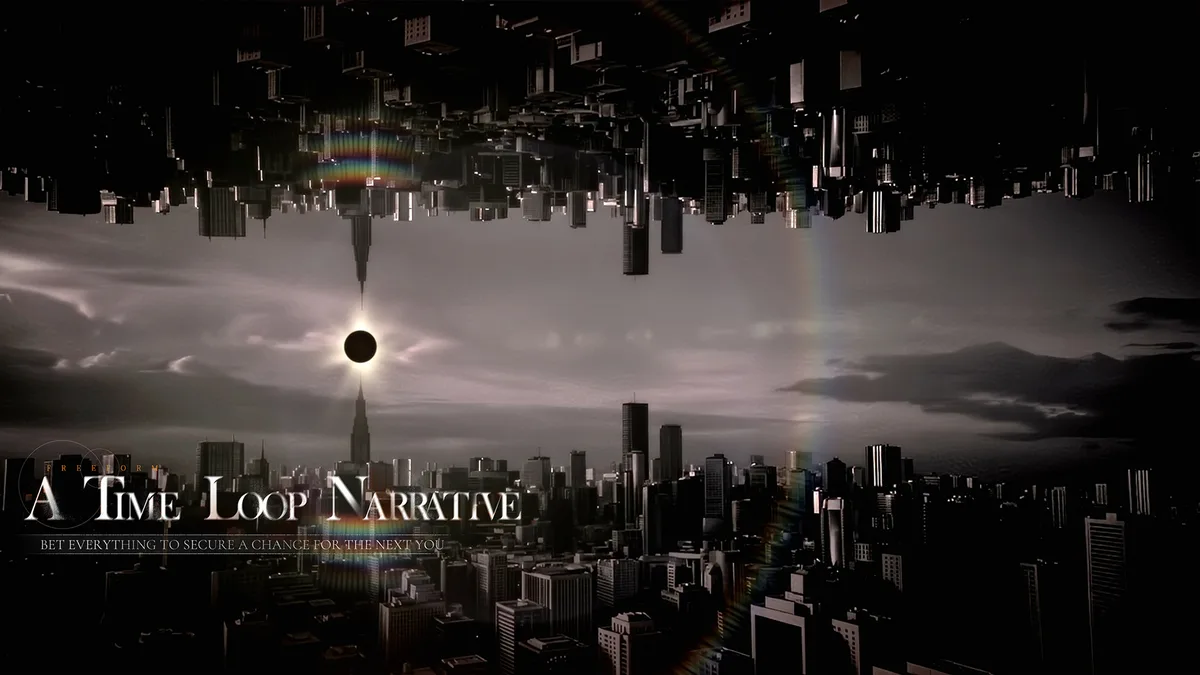
Official Silent Whispers key art — Archosaur Games / VVANNA STUDIO.
The City of Fading Light
The game takes place entirely within a fictional metropolis Archosaur calls the City of Fading Light. Rather than building an obviously fantastical or dystopian skyline, the official key art leans on recognizable, almost mundane urban furniture — sidewalk cafés, an elevated monorail curling between towers, a Ferris wheel lit up against a golden-hour skyline. The official description of exploration in this space is "freeform urban exploration," and the marketing tag attached to it — "roam freely, discovering connections around every corner" — frames the city itself as something to be explored on foot rather than fast-traveled between menu screens.
That grounded presentation is a deliberate contrast to what the story does to the city over time. Official copy states plainly that "the boundary between illusion and reality begins to blur" — meaning the ordinary version of the city players are introduced to is not meant to stay stable. How literally that manifests (visual distortion, unreliable NPCs, physically impossible spaces) hasn't been shown in detail yet, but the recurring "inverted skyline" imagery in official key art — a second city hanging upside-down above the real one, centered on a solar eclipse — is the clearest visual hint released so far.
The time loop, explained
Silent Whispers is built around a time-loop structure, officially described with the line "a time loop narrative" and the tagline "bet everything to secure a chance for the next you." Read together, that phrasing implies a loop that isn't free to repeat — each attempt costs something, and failure doesn't simply end the game, it sends the player back into another cycle with the stakes reset but (implicitly) some form of continuity intact.
This is a meaningfully different structure from a typical otome visual novel, where a "bad end" usually just returns the player to a choice menu. A loop framed as something to "bet everything" on suggests consequences that matter across attempts — memory, relationship standing, or world state that might carry over — though Archosaur hasn't published the actual save/reset rules yet.
Illusion vs. reality
The illusion-vs-reality premise is Silent Whispers' central hook, and it's stated directly in official marketing rather than left implicit. Combined with the time-loop structure, the implication is that what players experience as "real" city life — cafés, dates, casual exploration — is not guaranteed to stay separate from whatever is generating the loop in the first place. It's the kind of setup that otome and visual novel fans will recognize from other "the world isn't what it seems" romance titles, though Silent Whispers is pitching a first-person, 3D version of that idea rather than a text-driven one.
The city's dangerous "games"
Archosaur's own description of the core loop mentions players "entering perilous 'games' where survival and betrayal force difficult choices." The word "games" is used deliberately (and in quotation marks in official copy) — these appear to be structured, high-stakes scenarios within the city rather than free-roam danger, and betrayal is explicitly called out as a possibility, meaning the game is signaling early that the three leads themselves may not always be trustworthy allies inside these sequences.
What we're speculating about the 'games' structure Contains spoilers
None of this is confirmed — treat it as informed speculation, not a leak. Games framed around "survival and betrayal" with three romanceable characters commonly use social-deduction or trust-based mechanics, where a route's romantic trajectory and a character's reliability inside a "game" scenario are linked. If Silent Whispers follows that pattern, choosing to trust or doubt a specific character during a "game" could plausibly affect that character's route. This is a genre-pattern guess, not something Archosaur has stated.
The writing team: Blade Runner credentials
Silent Whispers' narrative and worldbuilding are credited to David Gordon and Hampton Fancher. Fancher is a co-writer of both Blade Runner (1982) and Blade Runner 2049 (2017) — a screenwriting pedigree that's unusual for an otome reveal and one that press coverage has repeatedly used as a hook when introducing the game. It signals that Archosaur is positioning Silent Whispers' writing as a differentiator, not just its Unreal Engine 5 production values.
What that pedigree will actually mean for tone is something to watch rather than assume: Blade Runner is defined by neo-noir atmosphere, moral ambiguity, and questions about what's real versus manufactured — all of which line up thematically with Silent Whispers' illusion/reality premise, but a romance adventure aimed at a broad free-to-play audience is a very different format from a Blade Runner film. Better to wait for actual story content than assume the tone will play the same way.
How the tone compares to other otome games
Most reveal-stage coverage has framed Silent Whispers as a direct genre peer to Love and Deepspace — both are 3D, first-person, free-to-play romance adventures with a small confirmed cast of dateable leads. Where Silent Whispers appears to diverge is in how much weight it's putting on plot mechanics (a time loop with real stakes) versus Love and Deepspace's more episodic, chapter-based structure. Whether that makes Silent Whispers feel more like a thriller with romance elements, or a romance game with thriller dressing, is something only playable content will answer — the marketing so far is deliberately balancing both halves evenly.
Story & Setting FAQ
What is the City of Fading Light?
The fictional metropolis Silent Whispers is set in — a city built from familiar urban landmarks (cafés, an aerial monorail, a Ferris wheel) that Archosaur has described as a place where "the boundary between illusion and reality begins to blur."
Is Silent Whispers a horror game?
No — it's marketed as a romance adventure with survival and thriller elements. The tone leans cinematic and tense in places, but the core genre is otome romance, not horror.
Who wrote the story?
Narrative and worldbuilding are credited to David Gordon and Hampton Fancher, the latter a co-writer of Blade Runner and Blade Runner 2049.
Does the time loop reset relationships with the three leads?
Archosaur hasn't detailed this mechanically. The official framing — "bet everything to secure a chance for the next you" — implies loops carry some continuity or cost, but the specifics of what resets and what persists have not been confirmed.
Last updated 2026-07-02.